My primary reason was to solemnize the wedding of friends, Eman and Natan.
Natan and I met several years ago in a small town near Geneva.
Soon after my arrival in Prague, Natan introduced me to Eman who hails from Sudan. It quickly became clear that Natan, a man of deep faith and courage, had met his match and found his soulmate.
I love expressions of courage and both bride and groom are overflowing with courage and joy and vision and care and so much else. Their combined natural charisma is as tangible as it is encouraging.
Natan and Eman met on a remote Indonesian island while each was pursuing a Masters Degree. They dated long-distance, and confronted multiple hurdles of visas, a war, and much else to make their marriage possible.
Natan announced at a wedding-preparation meal that they would honeymoon in South Africa and spend at least a day or two in Umhlanga.
Welcome to KZN, Eman and Natan, Mrs and Mr Ledvon.
May your next 50-plus or more years of marriage be as fun and beautiful as your wedding – and may some kind hotel guest be sure you see this column.
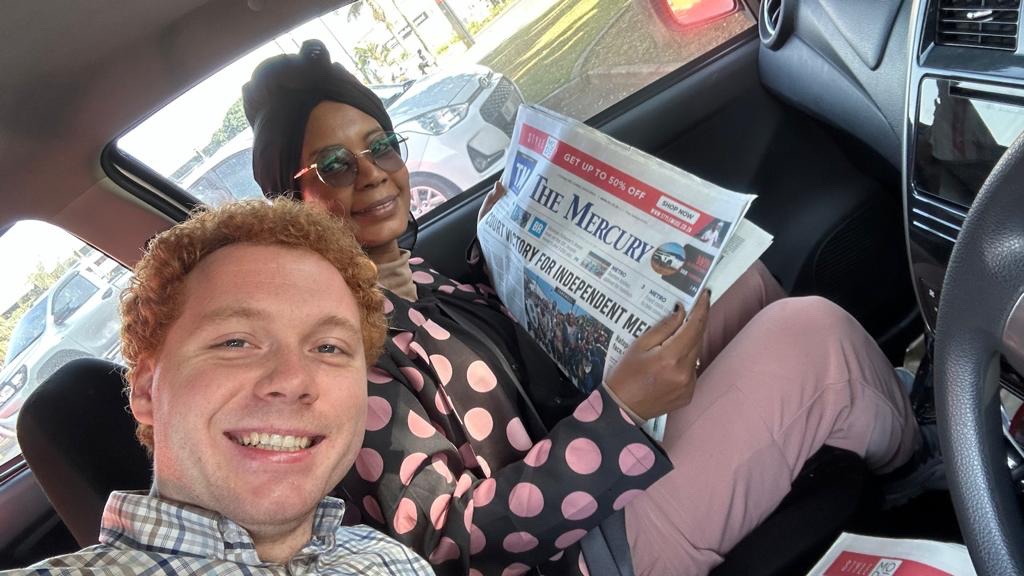
They’re on honeymoon abroad and get to read about themselves in a local paper. Content can be read above…..
My mind, my thinking, my brain — all that happens in my head — is quite good, still.
I know because half the time I beat my very bright friend “Obie” (and he was head prefect and dux of his school) in Words With Friends. Currently we are almost tied at 96/97 games. I’m not going to say who is ahead.
Besides beating Obie half the time I also know my thinking is just fine because I can remember stuff. I can plan activities. I can find my way in new-to-me cities after being lost for hours.
These are positive signs.
I also know when to use the words “fewer” and “less” and I’m occasionally successful in letting it go when others don’t. Every time someone says “have” when “has” is correct, and this does happen even on National Public Radio, I resist yelling “HAS.” I’m proud I possess a degree of restraint as demonstrated with the lackadaisical uses of “less” and “fewer” and “have” and “has” by many (even in influential leadership positions) and so I know I have the capacity to monitor my emotions (most of the time). Obie lives halfway around the world from me so he never sees how upset I get when I have a really good word all lined up to play and then he takes the place I planned to use, and so, rather than getting a bonus of 50 points for using all my letters, Obie wins.
I keep all these pent up emotions to myself which takes some brain willpower and useful skills of avoidance.
I certainly don’t want you to have the impression that my brain zips along and tackles everything with ease and success.
It doesn’t.
But, I can efficiently tell you how many South African rand you can get from any amount of US Dollars and if I don’t know I know how to ask SIRI.
I can tell you all about time zones and difficult things like the metric system.
I can even help you find Togo on a map.
What I struggle with is those new parking meters in Indianapolis where the print is so small on a screen half the size of a credit card and you have to put in your parking space number you forgot to look for when you parked. Even on good days I can’t find my car once I’ve parked it but with those new age parking meters my car is usually only a few spaces away and so after three or four trips back and forth I usually manage to enter the right number and add significantly to my 10,000 steps my phone insists I do every day.
Tangentially, when I park at the mall or someplace like that and I can’t find my car I lock and unlock the car from a distance with that thing that replaced car keys and follow the beeps. This usually works unless I’m in the wrong level of the parking garage which has also happened.
I’m really trying to say that my mind is in good shape, not perfect, but I trust it.
Mostly.
Some days — even for weeks — it can lead me down dark and scary passages and very lonely rabbit holes.
I can hear or see or read something, or I don’t hear or read or see something, and my brain makes it mean something and that something is most unpleasant, even unbearable and lonely to the max at times.
I read meaning into things and I get so convinced that I’m right and it makes me jumpy.
It’s at these times I don’t care how many times Obie wins.
Then, something happens (even if I drink strong coffee) or I read something or overhear a tidbit and put a few things together — a jigsaw-puzzle-with-thoughts kind of thing — and my head bumps into finding out I was wrong, very wrong, and I spent all that time being anxious in dark and scary places and lonely places for what.
For zilch.
Yes. I can spell onomatopoeia (without autocorrect) and I have known how for decades. I can beat Obie (half the time) in Words With Friends. I recently even did the parking meter thing successfully in Indianapolis and paid for the right car, mine.
Then, sometimes that same old brain takes me places, painful places, lonely places, I really don’t want to go.
When I sat in a tree and dangled my legs they seemed longer and could reach anywhere.
Mine did.
My legs could reach all the way to the ends of the earth.
I would wander next door into the Halgreen’s yard and climb a tree – I had a favorite tree – and dangle my feet from my branch and I’d see lines, like lines on a map. They’d come out the ends of each of my toes and race at high speed all the way through the vast expanse of surrounding trees and then leave the Halgreen yard and go into all the world. Some ran aground on the rocks of the uneasy coast-lines and were lost in the aggressive ebb and flow of pounding waves off Cape Horn. Others staggered slowly, as if they were hot and tired and thirsty into white-sand deserts and got buried and scorched, until they got a second breath and rose to the surface and burned like a firework fuse and continued their journey into the shifting haze of noon heat.
When I sat in my tree pointing my toes through Africa and beyond — this way to the Cape and the South Pole, stretching and pointing behind myself, straining my neck and my leg muscles — and that way, behind me, to the Sahara and the North Pole — the world was mine. I was connected to it. I could point to the opposite ends of the earth at the same time with each foot while my warm and soft heels touched each other like companions linked for an exciting adventure. My lines raced over the cliffs and through rocks and, ran under the oceans, inter-continental telephone lines, delivering voices to distant countries and ran up beaches and criss-crossed places like England and North America and Iceland, all from the ends of my curved bare feet.
My legs, locked at the knees, often became binoculars. I’d swing them higher and higher, searching Africa and the rest of the planet. One eye closed, using my big toes as view-finders, I could see to the end of our vast continent, deserts in the north, jungles in the middle, valleys in the south, beaches around the edges. Colors of bright days turned to night, vivid sunsets became hazy mornings and smells of foods and flowers and the sounds of music and voices rushed up my legs into my belly and from the insides of my being and warmed my heart. The Halgreen’s backyard forest gave me the continents and the continents danced in my heart. If I stood on the branch I could see all the way to our new brick house and, anytime I wanted, I could slip off the branch, leave my lines where they were and land on the rich, red and cool damp soil, and run home.
If you visit my home in small-town-USA I think you’ll be surprised by my art collection.
A local artist, and prolific one at that, seeing my framed prints – mostly European art – told me politely but pointedly that there is so much original local art that framing and hanging a print of anything is unnecessary.
I took that to heart.
Overtime, through the wonders of the Internet, I have purchased several pieces of South African art – and in making the purchase have talked with the artists.
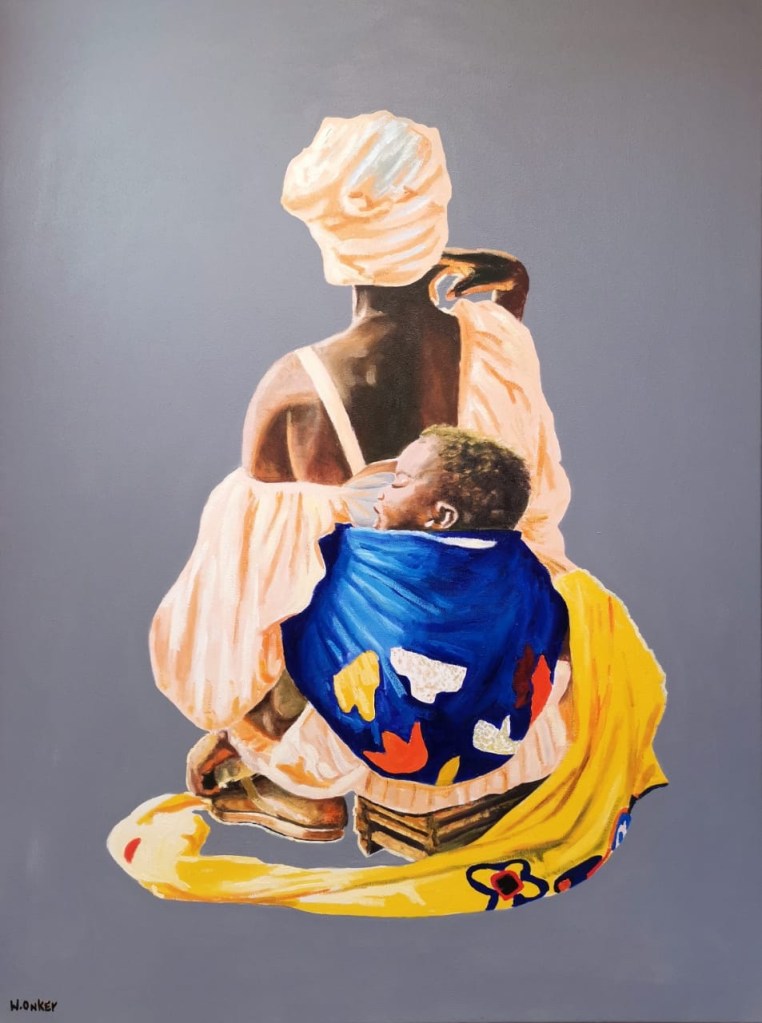
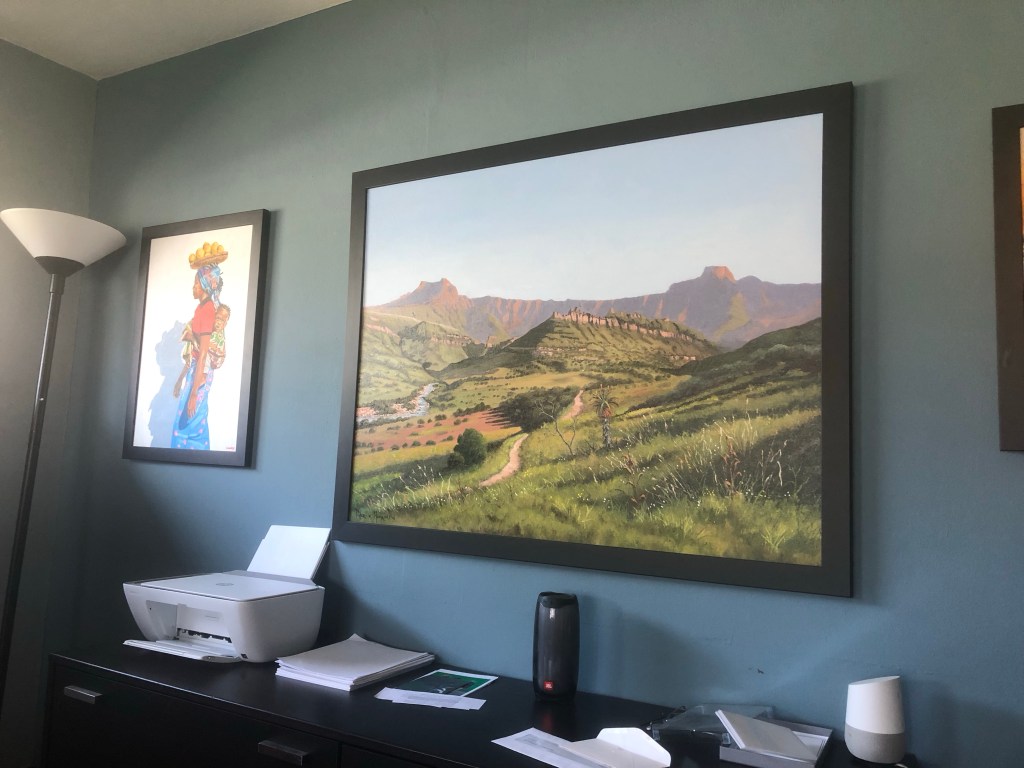
I love our large painting of the Berg’s Amphitheater by Peter VanHeereden which hangs in my counseling study. The living room has several Western Cape scenes and one large up close protea. A conversation starter and much loved piece is a painting of a woman with a sleeping baby tied to her back and a basket of fruit balance on her head. Each of these is by Western Cape artist Willem Onker. There are two breaking wave scenes by Pretoria’s Trevor Beach – who only paints waves!
It is all very beautiful and I love it all but our home screams one thing very loudly and very clearly: I miss living and being in South Africa.
May you meet gentle and warm hearted people and be warm hearted and gentle toward yourself and towards others. There appears to be so much fury and anger and so many people living on edge. May you and I offer a counter experience and offer others a place of welcome and safety. In doing so we may not change the world or make a shift or dent in our immediate environments but we will lift and encourage the hearts of a few.
May you be firm in your decisions and be confident in your dealings with yourself and others. There is a vast difference between confidence and arrogance and, while they are often confused, may you and I have only confidence. Inner-confidence permits others to take a stand, for themselves. Confidence will assist you and me to live deliberately and avoid victim thinking.
May you be generous and kind in a world that seems to promote selfishness, greed, indifference and even promote unkindness. This does not mean we have to give beyond our means or be un-thinking in our giving of time and resources. Wise giving of cash, talent, and time empowers others. Unwise giving of cash, talent and time will exhaust and deplete you and me.
I hear it over and over again – usually with a little whine in the tone.
It’s often whimpered as if happiness is some sort of award or a condition that may descend upon a person who is in the right place at the right time.
Truth is, you have more of a chance of being struck by lightning than you have being struck by happiness.
Happiness has no victims. It’s a by-product. It grows out of purposeful living.
Happiness remains out of control – even to the rich and powerful.
You may have noticed its penchant for playing hide and seek with the rich and powerful.
It’s yours when you fight and win the good fight over trying to be happy. It’s yours when you engage purposes greater than yourself, your pleasures, and appetites. The road to happiness is often paved with difficulty, things you may think will never deliver any joy.
It hides from the lazy, the self-indulgent, the entitled, the spoiled, the whiner, but embraces those seeking justice and authenticity and doing what is good and right by others.
Ironically happiness often escapes the rich and makes its home with the poor, the humble.
Oddly, it’s one thing that doesn’t, “follow the money.”
The freedom to be alone and enjoy time to think and plan and explore an internal world for reflection and growth and appreciation – with the love and support of significant others.
The freedom to share life with a diverse collection of friends and associates with whom values and goals are shared – with the support of significant others.
The freedom to reach out to family and extended family without explanation or apology — with the encouragement of significant others.
The freedom to investigate and discover new interests and passions quite unlike those previously pursued – with the support of significant others.
The freedom to confront situations that are fraught with unease or dissatisfaction with the hope of developing a plan to shift circumstances and move away from untenable conditions – with the support of significant others.
The freedom to change (and sometimes to fail at changing) established unhelpful patterns, habits that have resulted in painful consequences – with support and not cynicism from significant others.
The freedom to rest and recuperate from stressful days, weeks, months, seasons in order to re-enter life and productivity with freshness and zeal – with encouragement and support from immediate family and significant others.
The freedom to seek help from outsiders and for help to be confidential — with support from significant others.
I have had the joy of being with you this past week: several of you shared meals with me and we met in ways I know I will remember. I hope you will, too. Thank you. Given the time I would have enjoyed such an opportunity with each of you. During your first session with me I told you I would give you my notes from each of my talks. If you read this letter today or in ten years it is all ok with me. People do what they are ready to do. Keep them. See how well they age. Remind yourself that I repeatedly said I am addressing the future you.
Day One I tried to tell you how unique and beautiful you are. This is not an older adult attempting to convince you of something adults generally want you to believe. As I said I really have never met – 50 countries and thousands of people later – anyone, anywhere who is not beautiful. Yes, I have met people who have done really ugly things and done a few myself, but, you (we) are beautiful. Get to know any human by listening, really listening, and I believe you will soon agree with me. We talked about leadership: I said Leadership is a Function, a role, not a position. If your motive in becoming a leader is to see your name at the top of a list or to be the boss, your distorted motive will be your constant hurdle. Leadership is about who and what you are and what you do within a community. It is not about status. If it is the status you seek, your drive for recognition will persistently contaminate your leadership. To lead others effectively it is necessary to know what you are good at and what you are not good at. Work at your strengths. Accommodate your weaknesses. Both are yours for the long-haul.
I encouraged you to consistently define yourself. If you don’t, someone will. Resist the natural anxious urge to define others. Become an expert in your own behavior. Resist the natural (anxious) urge to be an expert in the behavior of others, especially those who annoy you. Listen more than you speak. Make sure you are hearing, not waiting to talk. I closed saying Self-Leadership has by far the greatest impact on how effective you are as a leader. If you can’t lead yourself you can effectively lead nothing and no one.
Day Two I emphasized your (and my) uniqueness. I urged you to find within the depths of where your hearts, minds, spirits, souls meet (see it as a kind of Venn diagram) the beautiful “place” generally referred to as the SELF. YourSELF is beautiful, it’s as unique as your fingerprints, your voice, and your personality. It is shaped by your family history, your DNA, by enduring joyful and nurturing experiences. It is shaped also by trauma, by loss, grief and so much else. This SELF is resilient. The Self wants to be well. It self-repairs (given conducive conditions). It is not Selfish to find and love and know yourSelf. I would suggest it is selfish NOT to. People who avoid Self-Awareness because they consider it selfISH are usually people who put stress on leadership teams and on friendships and battle with boundary confusion – “I am I, you are you, we are we, Let’s not confuse the three” – Remember? It’s corny BUT if you live it, it will save you a LOT of pain and therapist bills!
Day Three I emphasized your God-given desire for Autonomy. It’s part of your humanity. To desire self-directedness (AUTONOMY – SPACE, ROOM TO MOVE, freedom to be yourself) comes with your birth package. When it is unfulfilled – or ignored – you will be discontent. You have a similar God-given desire for Intimacy. This is part of your humanity. We all want some closeness, to belong, to be part of. Accepting that these Dueling Desires live within you and recognizing they are present in all the people will make it easier for you to welcome both into their legitimate place within your life. You (and I) really grow up when you (we) meet these needs in yourself AND understand that others are similarly driven. When your best friend chooses to be alone (wants Autonomy) it is not a rejection of you (necessarily) if you, at the same time, want Intimacy. Remember, you cannot LOVE and CONTROL the same person.
This afternoon (Thursday) and Day Four, I left you with eight things I would tell my younger self:
Save, and never touch, one third of all the money you earn. Few people regret having saved from an early age. Few things upset adulthood as well as financial pressures.
Honor your family and extended family relationships above all other relationships. If you are a brother or a son, a niece or an aunt, be the best one you can be.
Learn to live without blaming others. While others are indeed imperfect, blaming others for anything will seldom get you to where you really want to go. There are exceptions which I made clear (I hope).
Forgive, truly forgive, but remember. To forgive and forget is often foolish and even impossible. Remembering is not the same as holding a grudge. There are exceptions which I made clear (I hope).
Find your VOICE and hold onto it. Finding your voice means figuring out what you want your life to say. Only a small portion of finding your voice has to do with actual words.
Every unfortunate or bad thing that happens to you will ultimately offer you a choice. Will it become SEED (for growth) or STONE (resentment or hardness)? Seed will be most helpful to you. The choice will always be yours.
Pursue (chase) education even over romance. Few people regret having a sound education.
Gain understanding about your power, the power that comes with being human. Treasure it; Protect it, Deploy it. Use it for its intended purpose only.
I have loved being with you. Thank you. I especially enjoyed the Talent Show and the party. I loved watching your amazing capacity to have fun and I particularly enjoyed seeing some of you who arrived earlier this week appearing shy and withdrawn having the time of your lives.
Rod
Dad, Uber Driver, International Speaker and Newspaper Columnist
Save, and never touch, one third of all the money you earn. Few people regret having saved from an early age. Few things upset adulthood as powerfully as constant financial pressures.
Honor your family and extended family relationships above all other relationships. If you are a brother or a son, a niece or an aunt, be the best one you can be.
Learn to live without blaming others. While others are indeed imperfect, blaming others for anything you are will seldom get you to where you really want to go.
Forgive, truly forgive, but remember. To forgive and forget is often foolish and often impossible. Remembering is not the same as holding something against another.
Find your voice and don’t let others try to take it from you. Finding your voice means figuring out what you want your life to say. Only a little of finding your voice has to do with actual words.
Every bad or unfortunate thing that happens to you, once you have gotten over the shock, will offer you a choice. Will it become seed (for growth) or stone (resentment or hardness)? Seed will be most helpful to you.
Pursue as much education as possible even over and above romance. Few people regret having a sound education.
Gain understanding about your power, the power that comes with being human. Treasure it; Protect it, Deploy it. Use it for its intended purpose only.




 difficultrelationships.com