It’s enjoying face-to-face conversations, really listening to each other, responding, asking relevant, respectful questions. It’s encouraging people to talk about things they find interesting, important.
It’s sharing, refusing to dominate or set the agenda for every conversation.
Meals with friends, unhurried times, occasions when talk leads to laughter and may also lead to tears simply (and profoundly) because shared history is being re-lived.
Pain – revisited.
It’s simple meals that transform into events because hearts are healed even though a shared meal was the only intention.
It’s welcoming others, people known and unknown. It’s genuine openness, radical hospitality. It’s wild generosity. It’s sincere interest expressed.
It’s the simple things.
And, no cell-phones are required or necessary.
————
Two personal matters:
I will be in KZN from May 5 to May 15, 2024. Best selling author Terry Angelos (WHITE TRASH) and I will host a public seminar. During my visit I will, at your invitation, meet with groups, schools, churches, businesses, and individuals. Please contact Shirley@ShirleyWilliams.co.za to find out more about the Angelos/Smith event or schedule events with me.
This column appeared first in The Mercury on March 20, 2001 and has been published every weekday for 23 years. Thank you for your readership.
What kind of week will you have? What kind of person will you be this week? Ask these questions and most will say they don’t know or reveal a Que Sera, Sera (Whatever Will Be, Will Be) attitude.
It is possible to plan.
Here’s my five-point plan for this week:
I will do something every day that is an act of self-care and self-love. It is impossible to love others without also loving myself.
I will occupy the driver’s seat of my life. Abdication of this adult role to others – except under extreme circumstances – is the definition of selfishness.
Within the framework of my predetermined values and boundaries and my callings, I will be a highly cooperative person, a team-player, an encourager.
I will listen without waiting to speak knowing that every person has a voice worth hearing and something to teach me.
I will commit at least one specific act of unexpected generosity, one that costs me time and/or treasure, each day. This is to train my seeing, thinking and responding to others so that generosity becomes an ingrained way of life for me.
I’d love to see what you are planning for your week. Email me your 5 or 3 or 7 point plan.
It can be a line of a novel or verses of a psalm or a thought expressed by a friend.
Psalm 139 has been doing the rounds in my head lately……here are a few of David’s thoughts about David, David’s experience:
“For you created my innermost being; you knit me together in my mother’s Womb.” “….. your eyes saw my unformed body.”
A dad showed me a wallet photograph of his son, a beautiful, beautiful child, perhaps 8 or 9 years of age.
The dad was quick to express deep shame, even before telling me the child’s name, that he’d not married the child’s mother. He repeatedly said, his demeanor warped as he talked, he had sinned. His shame appeared to permit the dad very little room to ENJOY his child.
“How long will you punish yourself?” I asked, “when will you free yourself to really enjoy your son?”
Blank stare. Silence. He stared perhaps at the realization I would not join him in layering shame he so liberally embraced. The silence was perhaps needed to process the idea that his son, the “evidence,” could be enjoyed at all.
I experienced something similar with another person – when my sons were much younger – who questioned the validity and the Hand of God in my own family.
This godly man, and by all appearances quite a fine one, could not see my two adopted sons — a term I only use when pertinent to a particular context – as incredible gifts from an amazing kind, generous, extraordinary God. He harrumphed, could not celebrate my sons and me and was stuck with how my sons and I came together.
“Not God’s intent,” he concluded and EXPRESSED to me.
His theology trapped, then choked and strangled his capacity for any semblance of joy at our blessings and apparently he’d have preferred me to join him.
In both cases I saw “theology” or “church culture” or whatever suppress the joy of parenting and the joy of living.
It’s the goodness and kindness of God that leads to repentance — I think I’m just beginning to understand Romans 2:4.
I declare again, as I have many times in print and from the pulpit, every time a child is born we ought all stop whatever we’re doing (imagine it with me!) and fall to the ground, worship, and give thanks and then rise up and join hands and celebrate the miracle that is every birth.
May David’s insights about David as expressed in Psalm 139 become your insight about you and my insight about me.
There ARE NO ILLEGITIMATE children.
There are no unplanned pregnancies.
No child anywhere is an error.
May I remind you, even Jesus’ peers questioned his legitimacy.
Your family – blood-, marriage, relatives-by-choice, adoption, and any other means people become family – is vastly more than a list of people on your group-chat or birthdays to try and remember or the ready-made crowd for weddings and funerals.
The hundreds of links (a family of 4 has 16 relationships) in your network – your family – and how you are linked (just right, over-connected, under-connected, loosely-affiliated, cut-off in anger, the “I’ll never talk to him/her-again” kind of connection) is of crucial importance.
How you are connected will either sustain and support and nourish you or drain and exhaust you. And, there is no escaping. Severe disconnections can wield a driving power even in a so-called non-relationship.
We are all “linked” and positioned in a variety of ways within the same extended family and so a family can nourish and support while, at the same time, it can rip to shreds and bleed someone dry.
I’d like to avoid this dramatic contrast but simply look around — listen to people’s family stories — you’ll see it is so.
We are each integral to the health (and un-health) of our family.
We are each a cell-within-the-whole.
The healthier we are, the more “just right” our connections, the more we will be nourishers and be nourished within the unique group of people we each call family.
The healthier I am will lead to a healthier “we” even if it results in hardship* along the way.
* attempts at greater health will be met with resistance from those around, especially those who’ve “benefited” from unhealthy habits and patterns.
There is a difference between peacekeeping and peacemaking.
In a troubled emotional environment peacekeeping saps energy and can be a never-ending task.
Peacemaking lays groundwork for authentic peace to prevail.
Peacekeepers work hard to keep the tensions from rising and work at pretending that nothing is amiss.
Peacekeepers avoid conflict. Their reward is the semblance of tranquility, the demise of integrity and escalation of anxiety.
Peacemakers invite necessary conflict knowing there is no other pathway toward understanding between warring people and groups.
Peacekeepers can endure fake “peace” leading to feelings of being called or anointed while they tiptoe through minefields they pretend don’t exist.
Peacekeepers apparently “enjoy” feelings of martyrdom. How else would they rationalize the accompanying stress of trying to hide or tame the proverbial elephant in the room?
Peacekeepers often see their role as “spiritual” and “humble” because they endure without “saying anything.”
Peacemakers value authentic peace more than its distorted parody. The peace that exists between people who possess the courage to endure conflict, for the sake of lasting peace, is like pure gold when compared with its counterfeit cousin.
Move with courage toward lasting peace.
Assume your legitimate role as a peacemaker rather than avoid conflict in order to keep a semblance of peace that is not worth having.
Focusing on strength and in the hope of wild serendipity, I often encourage my beloved therapy clients (and sometimes family members) to break long-established habits and reach for the unusual, the unpredictable.
“What can you plan to take yourself and your family and friends by pleasant and even shocking surprise?” I may ask.
One client, living in Eastern Europe, took a few weeks to unveil his plan.
He took me by delightful surprise and declared he’d planned a solo train journey.
“Prague to London?” I questioned, thinking this would an adventure.
“Jakarta,” he said, “Prague to Indonesia, it will take a few months in trains and a short ferry ride right at the end.”
I suggested my Australian brother break his own rules, be a little edgy, take us by surprise.
Within 24 hours he announced he’d already fulfilled the challenge.
“What?” I enquired, “what unexpected and wild thing have you done in response to my challenge.
He confided: “I woke early this morning and, and walked to the bakery in UN-IRONED shorts.”
May you and I, somewhere between those extremes, break our established patterns, engage in something edgy, exciting. May our actions refresh us and inspire those around us to find their own version of taking themselves and others by surprise.
Backbone — a metaphor for courage. Your literal backbone keeps you upright. It keeps you standing. Your metaphorical backbone symbolizes your courage. I’ve met many people “slump” through life and stand for very little, people have been successfully filleted by themselves, by life’s trials, or by others. Spineless people are “easy meat” for high-maintenance, low functioning relationships. Access your backbone and shimmy up your spine. Love it. Strengthen it. Enjoy it. Deploy it.
2. Creative Brain
This is the part of your brain where you can think about thinking. It’s where you appreciate art and humor. It’s your realm of infinite possibilities. It’s your spiritual mind. It’s NOT your explosive or “fighting” brain or your “loves-me-loves-me-not” feeling brain.
Access your creative brain. Explore it and explore with it. Try to live with this part of your brain “driving” your behavior.
3. Voice
Your Voice and using your Voice embodies your willingness to speak your unique mind, to say what you see, think, and want, express what you think and want. It’s realizing that silence born of lack of courage or lack of confidence is seldom helpful to anyone. Many people have lost their voices in the name of love, submission, or in keeping peace. Access your Voice, deploy your voice, and persist with expressing the things that are important to you.
1+2+3=YOUR FORMIDABLE TRIANGLE
Once you embrace your Formidable Triangle you will be free to love yourself and others in ways that are healthy for all.
Over time, awareness of the three corners of your formidable triangle, and accessing each when necessary, will become “second nature” to you.
The corners will merge and form a firewall to protect you from draining relationships and exchanges. They will also merge and empower you to be your healthiest self under most circumstances.
To enjoy your Formidable Triangle ALL three corners are required.
Treasure and use your BACKBONE. Access your THINKING. Express yourself — your VOICE — loudly and clearly and you will attract healthy, high functioning adventures and relationships.
When first cousins Grace and Mercy show up from within you (they live rent free without exception within us all) and reveal their natural beautiful ways, human encounters get an added touch of the divine.
The cousins are hard at work and always ready to assist any person who wants to participate in acts of unmerited kindness. They play a willing hand in every expression of goodness and delight in participating in all moments of empathy. Mercy and Grace become especially evident and empowering when you express even a smidgeon of desire to offer forgiveness and generosity as a way of life. When we want them to influence and become “a way of life” they dance a little jig of joy.
When you and I permit Grace and Mercy to do their thing within us — they are always ready for an opportunity — no matter what may be our proclaimed faith or the absence or even the denial of one, we come face-to-face with our divine imprint.
Grace and Mercy will steadily reveal what wonderful tenants they are and transform any willing host of their counter-culturally subversive, loving ways.
May the sisters dance and have their way.
They will make you even more beautiful than you already are.
If it has to be earned, or can be traded or leveraged – it is not grace.
The millisecond an exchange of what is supposed to be full of Grace is tagged with expectation and is not freely given, it becomes something other than grace. It may be a bargaining chip, an attempt to control another, or something deployed in hopeful attempts to fix or change another, but, once it is currency of any sort, what is being “offered” is something other than Grace.
Grace is about the giver.
It is a reflection of the heart of the person – group, church, organization – freely giving it. It is not about the person or people on the receiving end. Is it not about whether it’s deserved or not, fair or not, or any one of those typical things people will say when someone has been the unlikely recipient of authentic grace.
Grace, with Listening (“You have my full attention”) and Presence (“I am here with you and for you”) are among the most powerful gifts we can offer each other.
Life itself tries to teach Grace to the willing learner.
May the learning curve be smooth and kind and gentle for you and for me.
When it seems that things are coming at you from all sides….
Hold onto yourself.
Even if you are surrounded by supportive loved ones, you are all you’ve got.
You are your own constant companion and your relationship with yourself is the longest relationship you will ever have – so you might as well be best friends.
You might as well learn to enjoy yourself.
How you treat yourself is (already) the platform from which you see others and it forms the lens through which you see all things.
When under pressure, don’t talk to everyone about what you are facing.
It’s a hopeful myth that all talking is helpful.
It’s not.
Choose a few trusted people and talk only to them
Spewing – freely-recalling, random mumblings, blaming others, yelling, speaking from a place of confusion or anger – has limited and few benefits.
Holding onto yourself involves planning what you will and will not share.
You are allowed to keep things to yourself.
You are allowed to plan and decide how you will behave, who you will be.
All this, and more, is all part of learning to hold onto yourself.
When you hold onto yourself, some will tell you are being selfish.
Self-awareness and selfishness are poles apart.
[I will be in Durban in February and April — not March — and would love to speak at your church, school, or fundraising event — make contact by email or private message.]
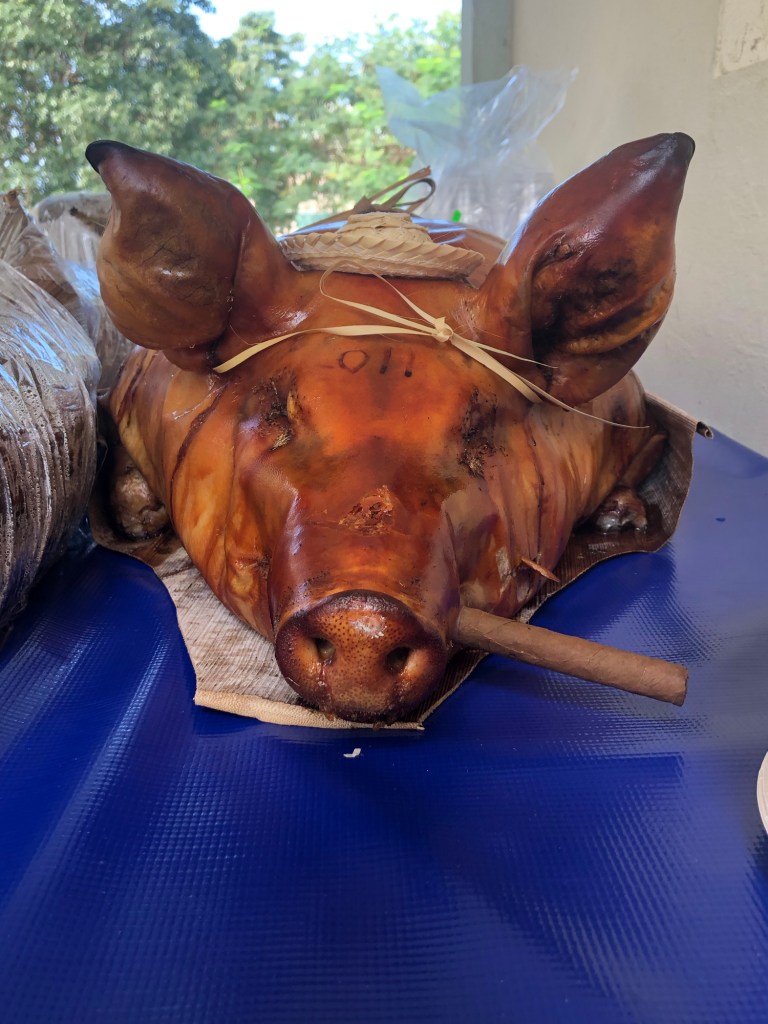
From a recent lunch in Cuba — note the hat and cigar. This vegetarian did not partake!




 difficultrelationships.com